Why Should Photographers Carry an ID?
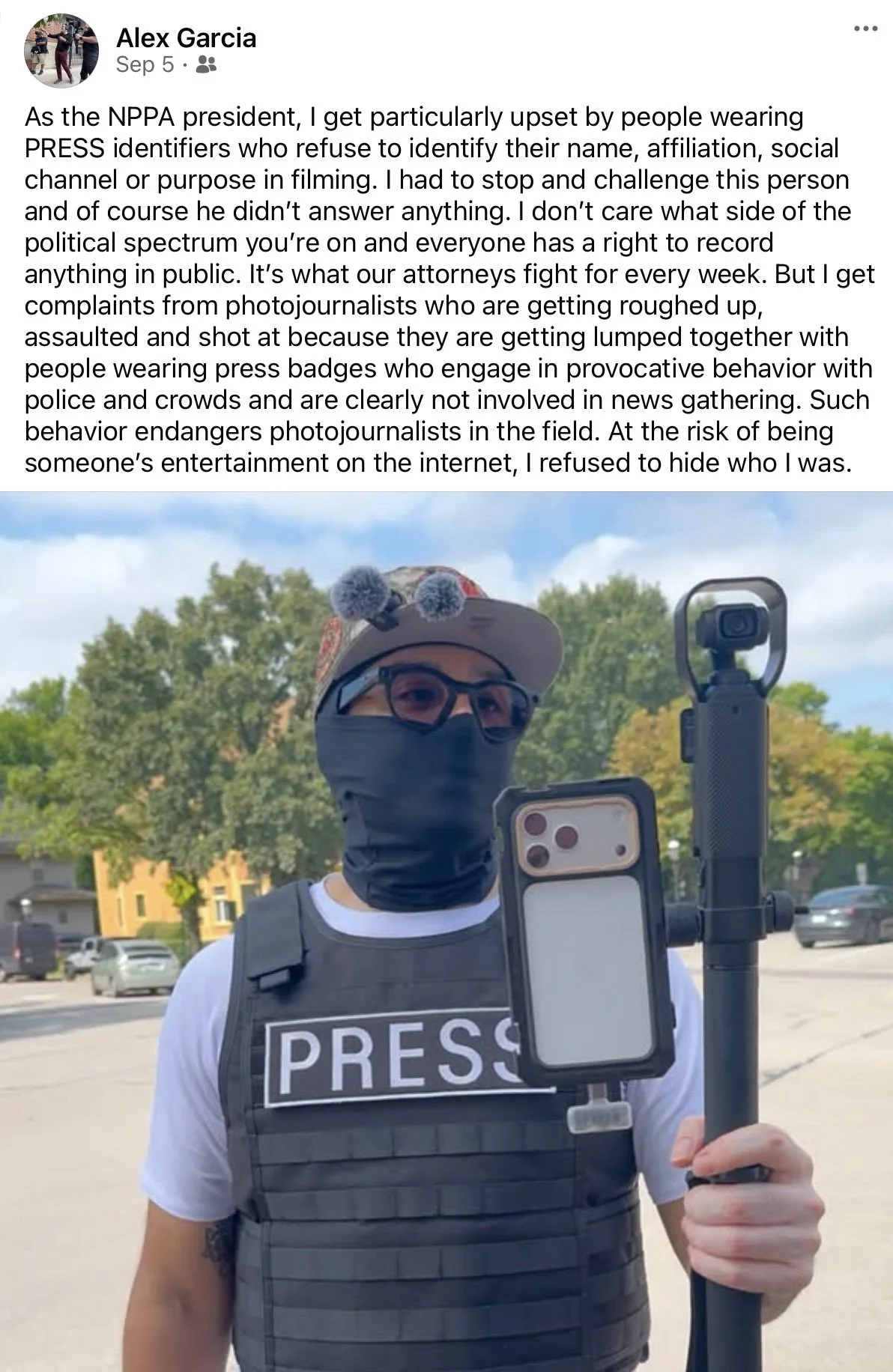
Recently, a Facebook post made by Alex García, president of the National Press Photographers Association (NPPA), threw light on an individual claiming to be a photojournalist carrying no identification badge while also covering his face. Garcia, who I personally met briefly in one of his trips to Cuba, showed concern about how these kinds of actions undermine, compromise and even endanger real photojournalists.
We currently live in a time in which the media is under constant attack and attention. Even with the First Amendment in place, there are attempts to put a gag on or completely cripple entire media outlets that are not in favor of certain policies. The trend to label journalists and media outlets as enemies of the state in the United States right now is taking a very dangerous turn, one that is reminiscent of really bad times for any person who has lived under a communist authoritarian regime.
That is why the presence of a possible agent provocateur is so alarming. Any person reporting some actions with a camera has the civil right to intervene, but the ethical obligation not to do so. As protests take place all over the country due to immigration policies and actions and pro-Trump rallies continue to happen, the current polarization of US politics increases the risk of verbal or physical confrontation among protesters. A masked person, wielding or not wielding a camera, can be seen as a threat by any demonstrator, as getting them confused with agitators or white supremacists is a permanent risk.
It can also create confusion if said demonstration is taking place in the presence of ICE agents who also wear masks—although the latter should not do so either.
Moreover, failing to identify yourself as a journalist and for whatever media it is you may be working could easily indicate you don’t have good intentions, mainly if you have already claimed to be working in the media. In other words, you are simply impersonating a journalist or photojournalist, which is not illegal as it is impersonating a law-enforcement individual. Yet, it is still immoral, and unethical, mainly if you are doing it to agitate or incite violence, both of which do constitute crimes.
As a member of Professional Photographers of America first and the National Press Photographers Association later, I have always carried a piece of identification with me if I was going to be shooting in public. The PPA ID does not have a picture, and I had to print it and laminate it myself. It is also more related to creative and commercial photographers than it is to journalists. However, I always carry it in my wallet, regardless of the other form of ID I may either be carrying in my bag or on display.
The NPPA badge, on the other hand, is a PVC piece of identification, and I have put it on to photograph St. Patrick’s Day Parades, the Halloween Parade in Collinsville, and more than one No Kings protest. Even while flashing my badge, I have been asked by individuals, and my response is “I am freelancing, I submit some of my images to SIPA USA or iStock by Getty Images. Clean and truthful answer, and nobody messes with me. I was even given access to a parking lot by a police officer once the street was closed just by showing him my NPPA badge.
Even while carrying their badges or credentials, photographers have been targeted by law-enforcement, protesters or both.
During the January 6 2021 storming of the US Capitol, Associated Press photographer John Minchillo was harassed by the rioters. He was pulled by his backpack, pushed against a wall, dragged by his media lanyard (so he WAS carrying an ID), and accused of being Antifa. He was not taking any stance, he was just documenting, and still, somehow, they managed to attack him and drag him down a flight of stairs. I remembered seeing the videos, and I was in total disbelief that something like that could happen in the United States.
It didn’t take long for me to see it in Cuba. Six months and five days later, Cubans stormed the streets to protest the government. Unlike the “official” version claims, they were demanding freedom. Anyelo Troya—already in the Cuban State Security’s radar for his role in the Patria y Vida video—came out to the streets to document the events. He ended up jailed and sentenced to prison, ultimately emigrating to the United States. Although it is true that Troya didn’t have a media credential, the charges of “public disorder” were preposterous and his sentence was excessive.
That same event brought credentialed Associated Press photographer Ramon Espinosa, stationed in Havana, to get beaten up by the Cuban police. He was not a protester: he was someone who had authorization from the Cuban government to be in the country and perform journalistic duties. Nevertheless, he was clubbed and beaten up, and the photograph of his bloody half-covered face (we were in the age of Covid-19) and his Sony Alpha in front of it circulated the planet.
More recently, Australian reporter Lauren Tomasi, of 9News Australia, was shot with a non-lethal bullet by an LAPD officer during the live broadcast of a protest taking place in Los Angeles.
While the First Amendment protects individuals who want to report and document what is happening around them—it has been proven to be effective and even save lives—, there is a difference between doing it out of solidarity, morbidity, attempts to go viral, and even citizen’s concern, and reporting from a professional and ethics-based standpoint.
Citizen reporters tend to take a stance, confront either side of a conflict, and intervene for what they consider to be the right cause. These positions have avoided many tragedies, keeping some law-enforcement officers or ordinary individuals from committing any type of abuse, or at least deterring them from executing people point-blank or lynching someone. And even when those attempts have failed, the video footage will serve to prosecute the culprit or at least unleash outrage due to the impunity of the crime.
Photojournalists, on the other hand, try to be as neutral and have as little impact as possible. The best they can do is help someone from the ground or take cover. The closest thing to engaging a media visual reporter should do is to get a little closer to the subject aiming to take the photo. It sounds cold and emotionless, but the integrity and safety of others are at stake. One photographer or videographer crossing that line will give everyone license to engage, leaving every other member of the media at the mercy of an angry mob (from either side of the protest) or vengeful and bloodthirsty law enforcement.
That’s why I believe there should be a law to keep people from impersonating journalists, the same way it should be mandatory for every member of the media to bear a form of identification akin to their reporting duties. After all, all individuals, as private citizens, have the right to pull out their phones or professional cameras and record.
So, they don’t need to pretend to be someone else to exercise their First Amendment rights. This, in my opinion, makes them automatically suspects of some wrongdoing, even with intent. The worst part is that they put photographers, videographers and journalists in extreme jeopardy. It just has to stop.