Why Are Cameras Seen as a Threat?
You are on the street, minding your business while people around you also mind their own business. Some walk, some talk, some people stand by the sidewalk, discussing the last game, the last political incident, or the top grossing movie. As you walk, some have their cell phones out, they snap pictures, take selfies, and even do live videos for their social media.
None of that bothers you. It’s the world we live in now. Mobile devices are more common than hats, more common than dressing properly, and certainly way more common than manners.
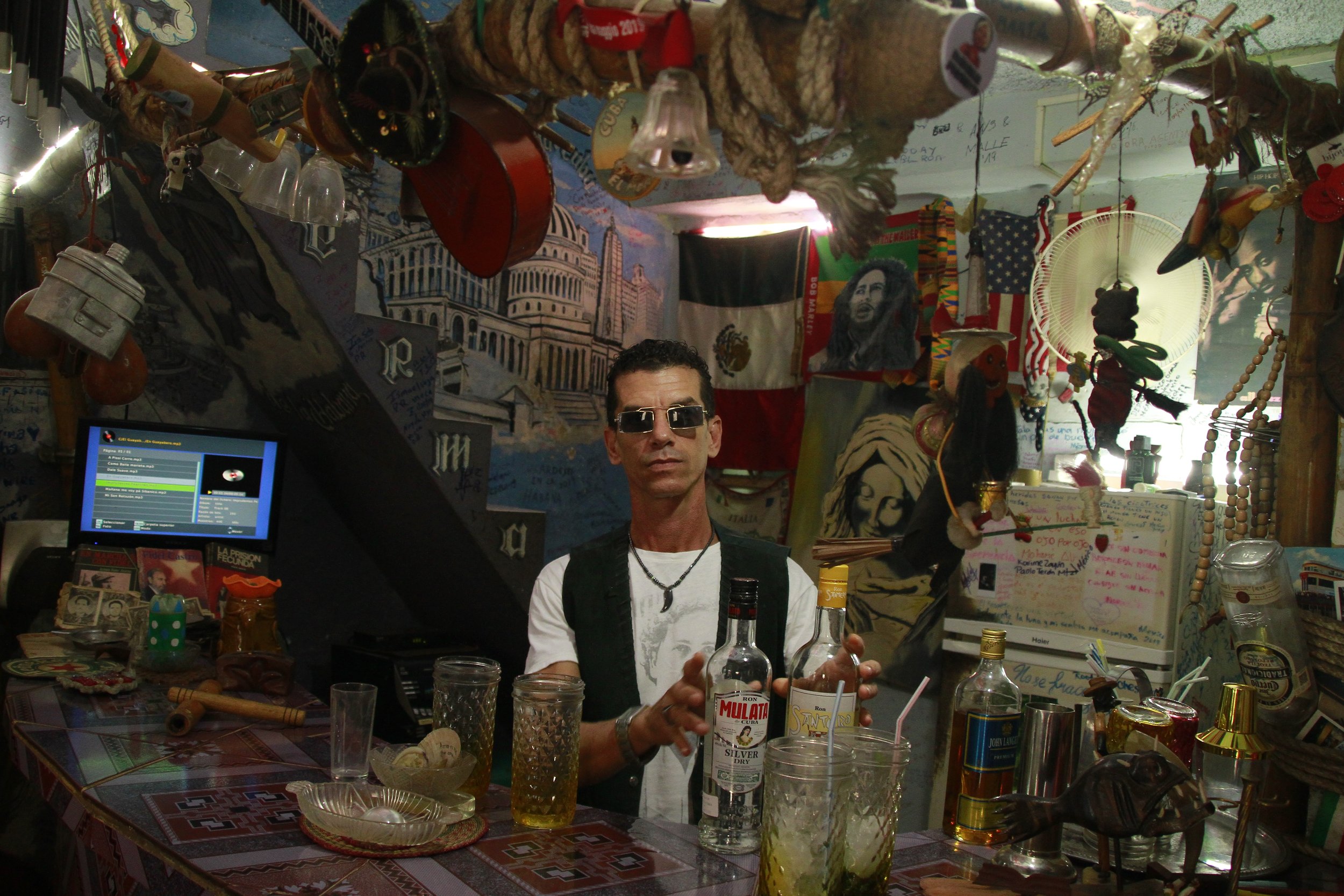
I was walking with a client from China in Havana in December 2019 when this man—whose name I forgot—stopped us and invited us to have a Mojito. He bragged about the size and the quality of his drinks, even told me what we didn’t have to pay if we didn’t like the drinks. They were cheap, but big and delicious. Years later, he went viral as “the Cuban Marc Anthony” for going berserk on a couple of influencers who didn’t want to pay. Seeing this photo, that he allowed me to take while he made our drinks, I believe HIM.|Credit: Reynaldo Cruz Diaz
All of a sudden, you spot a person, but that person is not wielding a phone. No. The person is holding a camera. They has a big lens (longer if it is a telephoto or wider if it is a wide angle, but big indeed). It draws your attention.
Now, you no longer see it as normal. You get uncomfortable, defensive, even confrontational. You now see that person, who nine out of ten times is trained in the techniques and the ethics of photo taking, as a threat. None of that happened before: no cell phone cameras posed a threat (even though some of them have higher megapixel resolutions than many DSLR and even mirrorless cameras). No video-making influencers-wannabes bothered you before.
You get bothered by the single one person (out of the many) taking your photo that will respect your image, your privacy, and will make you look good. Yet, “content creators” roam around you all the time, even without you noticing that they are doing a live video, and take your image without you realizing, probably making you look bad or worse, catching you in a situation in which you don’t want to be caught.
Why is that?
I still find it hard to understand. Living in Cuba most of my life, I had my first cell phone at age 32, and my first smartphone at age 34. To put you in perspective, that was 2015 and 2017. I visited the United States for the first time in 2016 and I had a smartphone while here, but once I got to Cuba, it was not compatible with the technology that ETECSA—the Cuban monopoly that controls cell phone and internet communication—ran.
So, over 99 percent of the images I took in Cuba were with my camera, I actually take photos with my camera at a 999 to one ratio compared to my phone. So, for me, the cell phone picture-taking trend not only came late, but also is still hard to understand and almost impossible to embrace. I use the cell phone for a picture when the lens I have on is not the adequate one for the image and I don’t want to let it slip away.
Nevertheless, we need to pose a question: why do real professional photographers need to worry about people’s reaction to their presence and their camera while everybody else wanders phone in hand, potentially filming or snapping photos at whim.
In Cuba, I experienced harassment more than once because of that. A couple of times I got singled out by people who didn’t want to be photographed (I get that, but they got aggressive). A couple other times I was harassed by the police—you all need to understand that there is not rule of law, and that police in Cuba do as they please with impunity, violating people’s rights all the time.
There was not a single time in Mexico or Canada that I felt any type of rejection. Au contraire, in both places, but mainly in San Miguel de Allende, people embraced my presence and had friendly engagement with me and the camera.
Here in the United States, there have been a couple of instances—Americans refer to that kind of people as Karens—in which someone didn’t like the camera and had even hostile reaction to it. One person even resorted to calling the police while I was sitting in front of the apartment where I was living at the time.
In the latter case, I had the camera out with a long lens because there had been sightings of red-tailed hawks, and I wanted to take a good photo of one if I got to see it. Several people walked by and even waved hello as I spoke on the phone to a friend from Cuba… obviously in Spanish. That—and not the camera—is what I think did it: they saw a Hispanic man, and automatically saw a threat. The cops, on the contrary, were very friendly and realized that I had been racially profiled. The proof is that one of them admitted having seen me several times walking around town and taking photos and had never thought of me as a problem.
With the development of cell phones today—and with how expensive photography gear is—the likelihood of someone using a pricey camera to case a neighborhood is unfathomable. The same goes for using pro gear for voyeuristic purposes. It is a dumb thing to do, because as someone holding a noticeable piece of equipment, you get spotted the second you walk into a room or out in the open.
There is no certainty in my mind for why this has become such an issue. It may be the fact that people find bliss in ignorance: being photographed with a phone does not necessarily tell them that they are being photographed, while the camera is something more evident and formal.
It is also true that male photographers suffer far more rejection and hostility than female photographers, although the latter do not escape public scrutiny fully unscathed.
The other side of the story
Different experiences have been lived by photographers all along. And I can personally attest to that. Many of the photos that I took in Cuba involved a friendly interaction with my subjects, some of whom even came to me to take a peek at the photo that I had taken and comment on it. The same happened while I was in Toronto, where even rolling down the window of my friend’s car to snap a photo didn’t make my subject flinch: she knew I was there, and she knew there was going to be a cool photo taken of her, so she went about her business and pretended I didn’t exist.
In Mexico, mainly in San Miguel de Allende, I was welcomed all the time. Street vendors, bar and restaurant workers, people from all walks of life embraced my presence and either pretended I was not there or gave me a great interaction. It is a different world: people in big touristy cities (whether locals or visitors) tend to be completely acceptant to the idea of being photographed. I lived it not only in San Miguel de Allende, but also in many areas of Havana and in my visits to New York City and New Orleans—places where about 70 percent of the people are travelers.
That probably explains why there are so many great photos of Paris, New York, Chicago, Tokyo, and many regions of Italy, Spain, Morocco, or Thailand—to name a few. Cosmopolitan environments may be forcing those who dwell there to realize that there will be people with cameras, that those people will be definitely taking pictures, and that they are subject to be captured in a frame.
Even in Connecticut, I can say that the good experiences outweigh the bad ones three to one. I have been stopped by people who have started conversations with me about photography, and even gotten my information or my card, followed me on social media and stayed on top of what I post on Instagram or my website. I have been welcomed to places to photograph, and I have had people pose for me on a street setting just for the sake of having fun.
A couple of bartenders on different locations, a couple of restaurant hosts, hostesses, waiters/waitresses and owners, the young lady at Barnes & Noble, the older lady at Walmart, the tellers at an antique shop, the guy at Petco, the people at Newington Public Market, a couple of liquor stores tellers or owners have all engaged with me in friendly conversations, and remembered me and asked questions about my photography and even my personal life.
Final thoughts
I tend to think that people who are bothered by a camera have a sense of self-importance. They may think—no offense intended—that they are being photographed by a professional is intended to damage their image, while content creators and influencer wannabes are doing live videos and selfies with them in the background.
Their biggest failure is that they don’t understand that the algorithm of social media will give more visibility to those people they don’t worry about than to the best photographers out there. The woman who posts pictures of her in a bikini and then either takes a selfie or does a reel of her restaurant (with those same people in the background) will probably get more visibility than a published professional photographer.
And then, they will blissfully walk away from that place, feeling accomplished for putting a true professional “in his/her place” while unprofessional people who have no training on photography or ethical knowledge about people’s images post their pictures or reels including them.
I think of this as divine justice, and a form of life showing sarcasm.